

The Pfumvudza conservation agriculture programme continues to transform farming practices in Zimbabwe, with experts highlighting its role in improving yields, promoting sustainability, and turning agriculture into a viable business.
Zadzamatura agronomist and sales and marketing manager Blessing Hatidane said the government-led initiative, supported by input suppliers, has proven effective because of its structured approach to farming.
“Pfumvudza is a programme that has been introduced by the government to farmers, and we, as seed companies, support our farmers using that concept of Pfumvudza to make sure that they get the full advantages of using the Pfumvudza method,” said Hatidane.
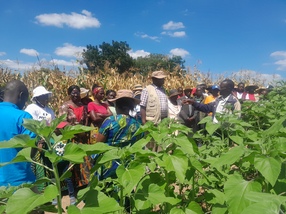
He was speaking in St Michales Mhondoro, Ward 3 after a field day with local farmers practicing Pfumvudza farming.
He emphasised that the programme’s success is largely driven by discipline in following recommended agronomic practices. “The reason why we have this programme, and why it has been a success, is because of the importance of timing in planting; farmers prepare their rows on time and carry out all the practices that they are instructed to do by the Agritex officers,” he said.
These practices include mulching, proper spacing, and other techniques that contribute to improved crop performance. Hatidane noted that the benefits are evident across the country. “So, the Pfumvudza concept has been successful in the country, where every farmer who has practised it has achieved the expected results of the programme,” he said.
He added that conservation is at the heart of the programme. “This means there is conservation of moisture, conservation of nutrients, and well-managed plots that result in good yields,” he said.
Hatidane also highlighted the importance of adopting a business mindset in farming, stressing that the choice of seed varieties plays a critical role. “The ability of a farmer to identify climate-smart varieties, which Zadzaatura is offering, then translates to success in terms of the yields that one needs. Farming as a business would then mean profitability on the side of the farmer,” he said.
He further noted that “there is assurance of profitability once a farmer chooses the right varieties,” adding that seed companies are providing options suited to different climatic conditions.
In addition to maize, Hatidane urged farmers to consider small grains as a way of mitigating climate risks. “We at Zadzamatura… also consider the issue of small grains for farmers, through the availability of sorghum seeds, millet seeds, rapoko seeds, and sunflower,” he said. “All these are crops that one can grow where rainfall is very minimal and where there is zero irrigation.”
He pointed to drought-prone areas such as Muzarabani and Masvingo, where diversification is critical. “You notice that… there is a need for them to also consider growing sorghum, millet, and sunflower… all these are small grains used to mitigate drought,” he said.
Chief Murambwa, who attended the event, urged local farmers to prioritise food production.
\"This is a Pfumvudza programme. We should learn to produce our own food. After producing for your family, produce for resale, then for export. That is how we end hunger,\" he said.
