

Farai Mabeza
As climate uncertainty tightens its grip on Zimbabwe’s agricultural sector, more commercial farmers are beginning to rethink their dependence on maize and turning to traditional grains seen as more resilient in dry conditions. In Mashonaland East’s Seke district, farmer Martin Matsa is among those betting on sorghum as the future of farming in a changing climate.
For Matsa, the shift was driven both by environmental realities and operational challenges on the farm.
“One of the reasons is the seasons are changing in this country,” he said. “And I also had very serious problems of pilferage of irrigation equipment.”
The theft of irrigation infrastructure forced him to reconsider crops that require less water and lower production costs. Sorghum, known for its drought tolerance, emerged as the obvious alternative.
“I said, since my irrigation equipment is very little now, I can’t cover a lot of distance with it. And I need to find a crop which is more than just guaranteed that I will harvest something if it doesn’t rain. So that’s how I went into sorghum,” he explained.
For centuries before maize became dominant under colonial agricultural systems, many African communities relied on traditional grains such as sorghum, millet and rapoko as staple foods. These crops were well adapted to local climates, required less water and formed a central part of indigenous farming knowledge and diets across the continent.
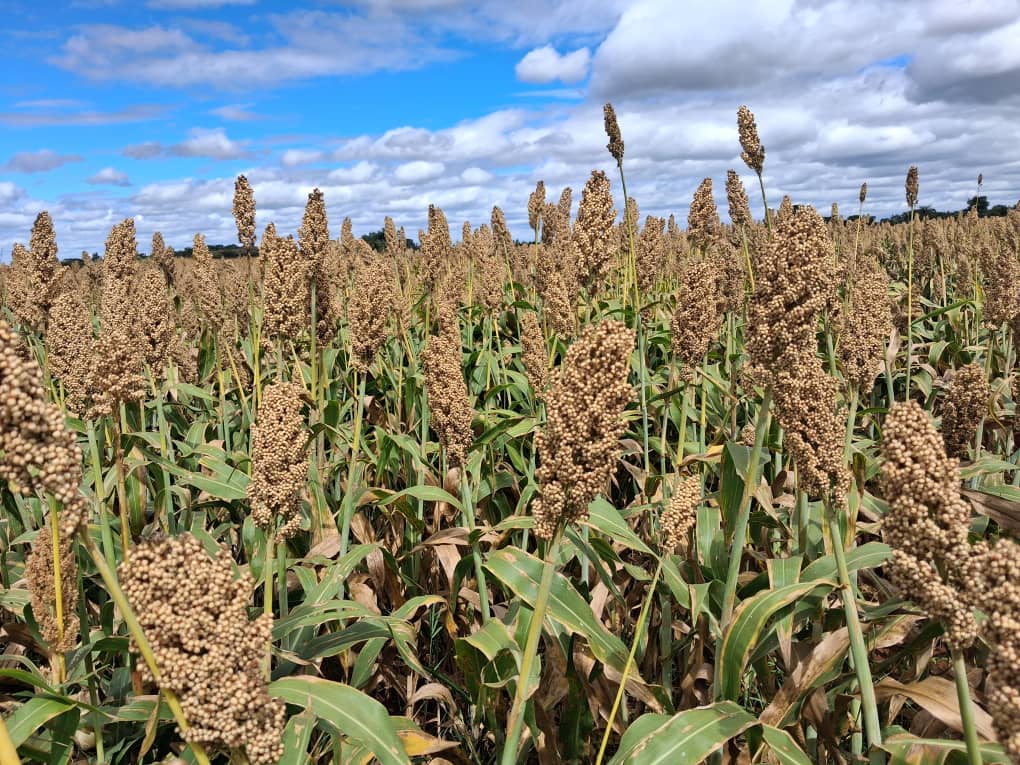
This season marks his first attempt at growing the crop commercially. While cautious about the outcome, Matsa believes the economics already make sense compared to maize production.
“It’s my first crop growing sorghum. Well, I just tried. I just hope I’ll get back my money and a little bit more,” he said.
The relatively low production costs are one of sorghum’s biggest attractions. According to Matsa, growing the crop costs roughly a third of what farmers spend on maize.
“It’s about a third of the cost of maize production. This is about US$300 per hectare, inclusive of everything. Maize, you’ve got to go above US$1,000.”
The farmer is already planning a dramatic expansion. Convinced that rainfall patterns will continue deteriorating, he intends to dedicate his entire 100-hectare farm to sorghum during the 2026 summer cropping season.
“I’m looking at putting the whole hundred hectares on the farm on sorghum this coming season,” he said. “Because I’m reading that it’s going to be a very bad year in terms of the rains. So we’ve just decided to go sorghum for the whole season.”
“The whole summer crop for 2026. And then we’ll see how it goes. If it gives us better yields than what we have this year, I think we’ll adopt it every year going forward.”
Beyond climate resilience, Matsa sees growing market opportunities for sorghum as consumers, stockfeed manufacturers and breweries increasingly embrace traditional grains.
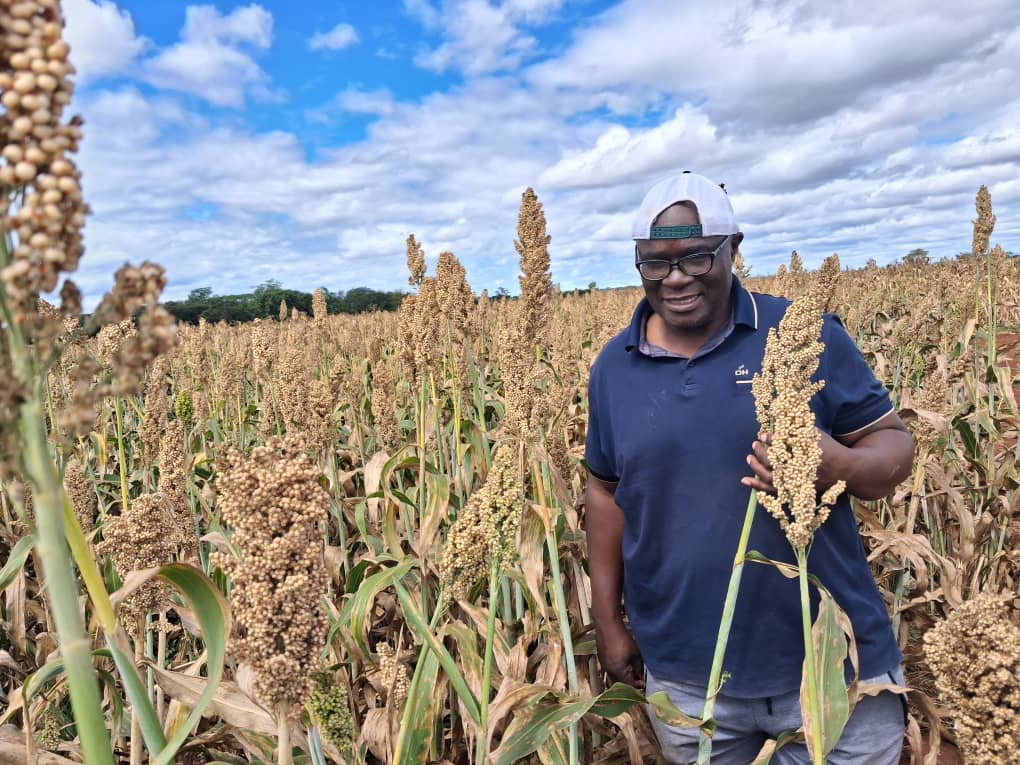
“The market is quite huge. It’s actually something that is being adopted by many people to use it for food,” he said.
“And also it can be used for stock feed. And you can also take it to the breweries and they can do some beer with it. So it is quite a number of uses.”
He added that management challenges are relatively minimal compared to other crops.
“Doing this crop, there are not many challenges. If you do the weed control well and you do pest control well, it’s one of the best crops.”
As interest in sorghum and other traditional grains grows, seed companies are also repositioning themselves to service what could become a rapidly expanding market.
Zadzamatura managing director Daniel Myers said the company is actively enrolling commercial seed growers for crops suited to Zimbabwe’s drier regions, including sorghum, millet and sunflower.
“As a company, our strategy is to actually enrol seed growers in the commercial sector for sorghum, millet, sunflower and make sure that these products are now taken to the drier conditions in the country,” he said.
Part of the company’s approach involves demonstration plots designed to educate farmers on best production practices and showcase how the crops perform under dryland conditions.
“We do demo plots, then we invite farmers to come and have a look and we then discuss all the agronomic practices that are needed in terms of plant population, fertiliser, pest control and the harvesting procedure and storage,” Myers said.
He noted that farmers are increasingly approaching agriculture as a business venture and are keen to see reliable returns per hectare before adopting new crops.
“Our focus is to make sure that the product is popularised with commercial farmers and also then the seed is extended to wide growing areas within our small scale farmers.”
Myers believes traditional grains are no longer just fallback crops for marginal regions, but a necessary insurance policy even in high-rainfall farming zones increasingly affected by erratic weather.
“I would say all the farmers that are in the dry areas, they need to adopt these traditional grains,” he said. “But also in the high potential areas, when you are now faced with a drought coming in a season, these are the crops to fall back to.”
