

Zimbabwe and Zambia are advocating the elimination of trade barriers to strengthen economic integration as they convene their first bi-national commission in Harare.
With the bi-national commission, Zimbabwe and Zambia elevate their long-standing Joint Permanent Commission on Cooperation into a higher mechanism for strategic collaboration.
The bi-national commission\'s central goal is to coordinate efforts on trade, infrastructure, and bilateral relations for tangible outcomes.
“Zimbabwe has 16,6 million people. Zambia has 22 million people. (That is a market of) 38 million people. We cannot develop Zimbabwe, and we cannot develop Zambia using colonial rules.
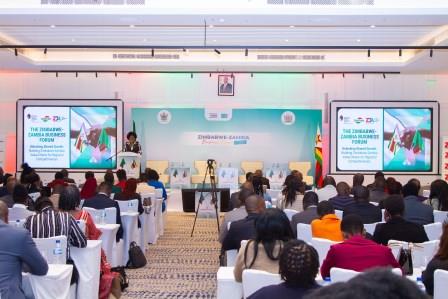
“Let the goods move. Let the people move. They have moved before. They will move again. So why don’t we make new laws that make goods move, that make people move, commerce move?” Zimbabwe’s Foreign Affairs and International Trade Minister, Amon Murwira, said on Thursday, during the Zimbabwe-Zambia business forum, which preceded the bi-national commission.
The forum was jointly organized by ZimTrade, Zimbabwe Investment Development Agency, and the Zambia Development Agency.

“If there are two business people (from Zimbabwe and Zambia) fighting, it’s them (fighting); it is not Zimbabwean business and Zambian business that are fighting. So (they must) finish it (themselves). Therefore, the tariffs must fall. This gathering is a new chapter.”
“We are forward-looking. As we continue to strengthen this partnership, it is imperative that our cooperation translates into tangible benefits for the people of Zambia and Zimbabwe.
“And for that to happen, tariff and non-tariff barriers must fall to zero. We are the only two countries in southern Africa, and I think in Africa, that jointly own assets, that jointly operate assets, for example, Kariba under the Zambezi River Authority. So, we must be an example of integration.”
He stressed the importance of free movement.
“Why do you think Zimbabwe will be filled with Zambians and Zambia will be filled with Zimbabweans? They will always go, but they will come back. If they want to stay, it’s okay. As long as we know where they are, there is no problem.
“What is the risk if a person goes to shop in Lusaka? What risk is there? I thought it was a gain. What\'s the risk if Zambians come and shop in Zimbabwe? Who is taking it as a risk? There is no risk. That is exactly what we are looking for.
“There must be hordes of people moving in between buying and selling things, laughing together, drinking together, eating together. What is the risk? Who painted that devil? A painted devil is harmless.”
Zambian Minister of Commerce, Trade and Industry, Chipoka Mulenga, said tariff barriers were an impediment to the growth of African economies.
“The biggest problem comes when we begin to bring back tariff barriers. Allow Zimbabwean products to come into Zambia with ease. Let\'s eat their food. It\'s organic. We know how they are producing it. Even in Zimbabwe, allow Zambian products to enter your market. It\'s organic. We know how they are producing it.
“The people who put up borders for us are trading with each other while we fight and compete against each other. In the European Union, more than 70 percent of its trade is within itself. Intra-African trade is less than 20 percent of total trade. We take the rest of the money out (of our continent),” Mulenga said.
Relations between Zimbabwe and Zambia predate the two countries’ independence, when the then Southern Rhodesia (present-day Zimbabwe), Northern Rhodesia (now Zambia), and Nyasaland (now Malawi) belonged to the federation of Rhodesia and Nyasaland.
Following the break-up of the federation, Zambia, which had attained its independence in October 1964, played host to Zimbabwe’s liberation movements alongside liberation movements from other Southern African countries, South Africa, Namibia, Mozambique, and Angola.
After Zimbabwe’s independence in April 1980, the two countries established diplomatic relations at the ambassadorial level.
