

The Securities Commission of Zimbabwe (SECZim) says participation in capital markets remains very low as the country seeks to widen the bands of financial inclusion.
SecZim is an independent regulator of the capital markets in Zimbabwe, including collective investment schemes, private equity, and venture capital.
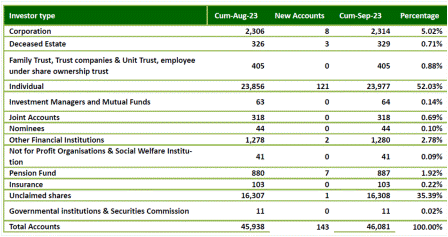
“Our CSD (Central Securities Depository) accounts confirm that plus or minus 45 000 clients are participating on the capital markets with plus or minus 2 000 corporations and 25 000 individuals.
“That’s not a big number. This gives a snapshot of the extent to which capital market products are being consumed by our population. There is a lot of financial inclusion that still needs to be done, and we are happy that through innovation, that can be improved over time,” SecZim principal officer for supervision and surveillance, George Nhepera, told a recent financial indaba organized by the Reserve Bank of Zimbabwe.
Financial inclusion is a national priority, articulated in Zimbabwe’s National Financial Inclusion Strategies (NFIS I: 2016–2020 and NFIS II: 2022–2026), and reinforced in national planning instruments such as the National Development Strategy 1 (NDS1: 2021–2025) and the upcoming NDS2 frameworks.
“These policies emphasize expanding equitable access to affordable financial products and services to women, youth, MSMEs, rural populations, and people with disabilities.
“While banking sector innovation has progressed rapidly, capital market inclusion remains more limited, constrained primarily by awareness, affordability, accessibility, and perceptions of complexity,” Nhepera said.
“Digital financial inclusion in capital markets is a journey that we have just started. Concentration of products in equities and bonds has led to few instruments tailored to retail and inclusive investment goals,” Nhepera said.
“Regulatory complexity for start-up fintechs also slows deployment of innovative products. …There is low availability of risk capital for MSMEs and the MSMEs continue to rely heavily on informal financing,” he added.
“Capital market innovation has the potential not only to unlock investment and enterprise growth, but to enable inclusive and sustainable development—ensuring that women, youth, MSMEs, rural communities, and persons with disabilities participate meaningfully in Zimbabwe’s economic recovery and transformation.”


