

Farai Mabeza
Zimbabwe’s long-standing ambition to move beyond exporting raw commodities and build a value-added export economy is steadily becoming a reality, with the latest trade figures showing encouraging progress.
According to data released by ZimStats for the period January to April 2026, Zimbabwe recorded cumulative export earnings of US$3.57 billion, representing a 48 percent increase from the US$2.41 billion earned during the same period in 2025.
The growth also contributed to a significant reduction in the national trade deficit, which narrowed from US$582 million to US$295 million.
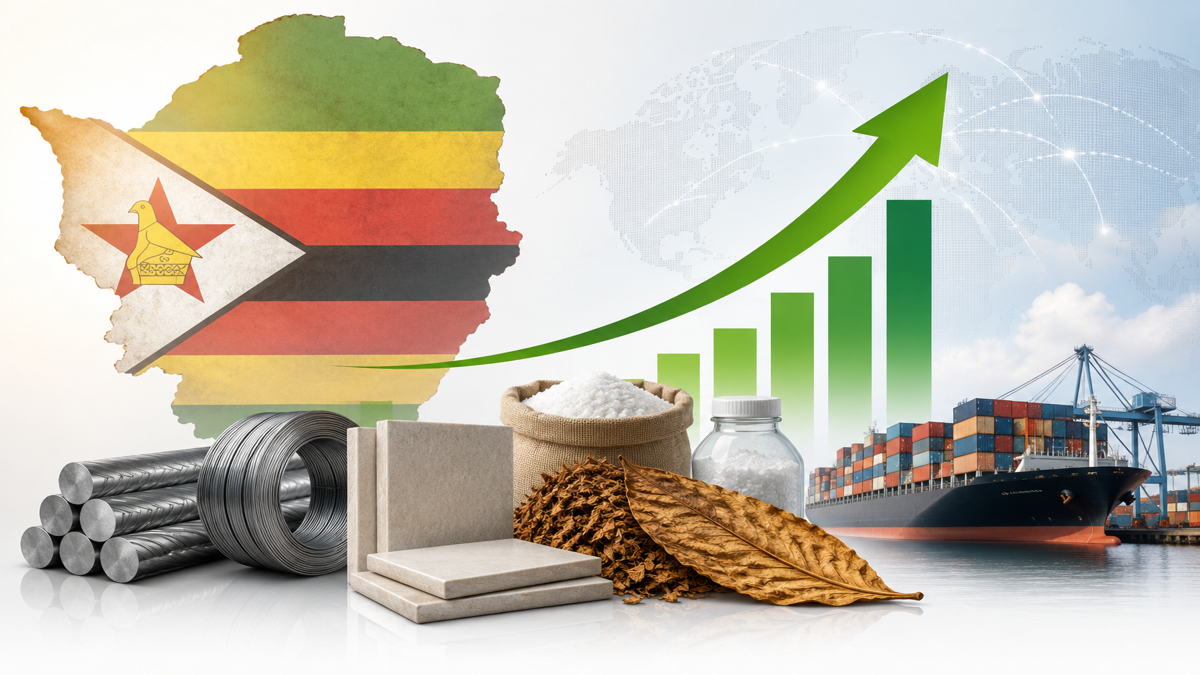
More importantly, the figures point to a growing contribution from manufactured and processed products. Value-added exports rose by 34.4 percent from US$149 million in 2025 to more than US$200 million in 2026, underscoring Zimbabwe’s efforts to move away from dependence on raw commodity exports.
The expansion is being driven by several key sectors. Engineering steel products recorded one of the strongest performances, with exports surging by 165.6 percent to US$77.9 million from US$29 million in 2025.
The increase has been largely attributed to growing local production capacity, including output from major industrial investments such as the Dinson Iron and Steel project.
Manufactured tobacco exports also increased by 33.5 percent to US$45.9 million, reflecting efforts to retain more value within the country’s tobacco industry.
Meanwhile, exports of building and construction materials rose to US$9.5 million from US$9.1 million, supported by demand for products such as ceramic tiles and related materials.
The growth aligns with the National Development Strategy 2 (NDS2), which seeks to increase the share of value-added exports from a 2025 baseline of 5.5 percent to 18.4 percent by 2030.
Another notable development has been the rise in processed mineral exports. Sulfates, including alums and persulphates, generated US$12.6 million in April 2026 compared to just US$357,000 during the same period last year.
The increase follows the commencement of processed lithium exports after government measures aimed at promoting local beneficiation.
ZimTrade Chief Executive Officer, Allan Majuru, said Zimbabwe’s recent nomination to the United Nations Security Council for the 2027–2028 term could further strengthen the country’s trade prospects.
“The UN Security Council nomination accelerates current trade initiatives aimed at growing exports by elevating Zimbabwe\'s profile on the world stage, where commercial negotiations often follow global credibility,” Majuru said.
He added that the enhanced international standing would complement ongoing efforts to open new markets for local products.
“This enhanced standing is expected to complement ZimTrade\'s ongoing work, particularly in accessing new markets,” said Majuru.
Through trade missions, bilateral engagements and market scans in countries such as Zambia, Vietnam and Thailand, Zimbabwe is increasingly positioning itself not only as a supplier of raw materials, but as a competitive exporter of higher-value products capable of generating greater earnings, creating jobs and strengthening the national economy.


